Map what actually happens
Begin during ordinary maintenance, not only after a severe storm. Record where water collects, how long it remains and which areas recover first. Compare rainfall with irrigation records and recent traffic. A wet strip that follows a sprinkler pattern suggests a different investigation from a depression that holds runoff from several directions.
Find construction drawings, renovation records and drain outlet locations. Distinguish native soil from modified soil and purpose-built sand rootzones. A field at Fenway Park, Wrigley Field or another established venue may have undergone many changes, but its name alone tells you nothing reliable about the current profile. Base decisions on the specific construction and its present condition.
Inspect the layers
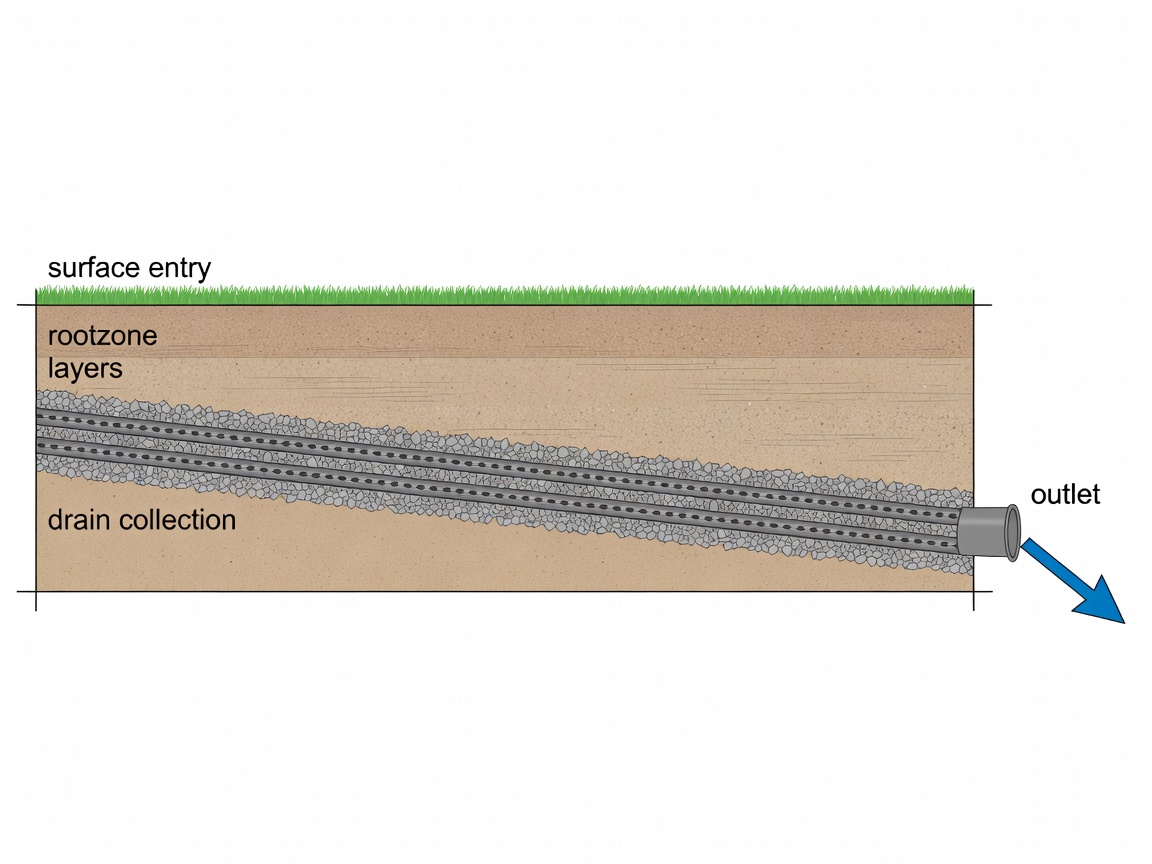
Use representative profile samples, taken with permission and repaired properly, to examine roots, organic accumulation, texture and abrupt changes between materials. Compare a wet location with a better-performing location. Roots stopping at the same depth can reveal a restrictive layer, although root distribution must also be interpreted alongside temperature, species and seasonal growth.
A sand layer over a finer soil does not automatically create rapid drainage through the entire profile. Water movement across contrasting materials can be complex. Likewise, adding coarse material to the surface without a compatible long-term plan can create a new interface rather than solve the original problem. Ask a qualified agronomist or soil laboratory to evaluate uncertain material combinations.
Compaction reduces the connected pore space that admits air and transmits water. It may be concentrated near equipment routes or high-traffic positions rather than distributed evenly. Organic accumulation can also slow surface entry. Treat these as separate possibilities: the same cultivation method will not necessarily correct both, and neither diagnosis proves that a buried pipe has failed.
Measure consistently
Simple repeatable observations often answer the first operational question. Mark inspection locations, use comparable sampling depths and note recent rain or watering. Portable moisture probes can identify patterns, but calibration and soil contact matter. A numerical threshold copied from another venue may be misleading when the instrument, salinity or rootzone differs.
Infiltration tests describe entry under the conditions of the test; they do not by themselves certify whole-field drainage capacity. The USDA Natural Resources Conservation Service offers soil-health educational resources that explain why texture, structure and pore continuity matter. For construction or acceptance testing, have a specialist specify the appropriate method and interpret the result in its engineering context.
| Observation | First checks | Avoid assuming |
|---|---|---|
| Water on the surface | Grade, sealing, antecedent moisture | Every pond needs a new drain |
| Wet roots below a dry top | Layering, depth, outlet condition | The profile needs more irrigation |
| One dry patch | Coverage, roots, water repellency | The entire field is under-watered |
| Slow recovery after rain | Rain history, compaction, discharge | One test explains every event |
Match the intervention to the restriction
If distribution is uneven, inspect irrigation heads, pressure, nozzle selection and obstructions before increasing the run time for every zone. A catch-can audit can reveal a pattern that visual inspection misses. Where localized dry spots persist, investigate rooting and repellency rather than assuming a larger total water volume will reach the intended area.
Where traffic has compacted the surface, choose cultivation that reaches the affected zone and fits the recovery window. Where grades have deteriorated, surface correction may be more relevant than deep work. Where collector drains or outlets are obstructed, arrange competent inspection and maintenance. Locate utilities and buried services before any excavation; do not enter drainage structures or confined spaces without appropriate authorization and safety systems.
Major rebuilding requires design rather than improvisation. Particle-size compatibility, drain spacing, grades, discharge permissions and downstream capacity all interact. A USGA putting-green recommendation is not automatically a baseball-field specification. Engage a sports-field engineer and agronomist to develop requirements for the actual use, climate and budget.
Verify under comparable conditions
After the work, repeat the inspection route and compare events with similar starting moisture and rainfall. Faster recovery after a small shower does not prove performance in a prolonged storm. Record both improvement and remaining limitations. Keep machinery off vulnerable wet areas where possible, because a rushed recovery operation can undo the gains by smearing soil or creating ruts.
Translate findings into the daily plan: which zones need targeted water, which routes should stay closed and what conditions trigger another assessment. Drainage management succeeds when it changes decisions on the surface, not merely when the drawings show more pipe.